

 6:05 am - October 15, 2026
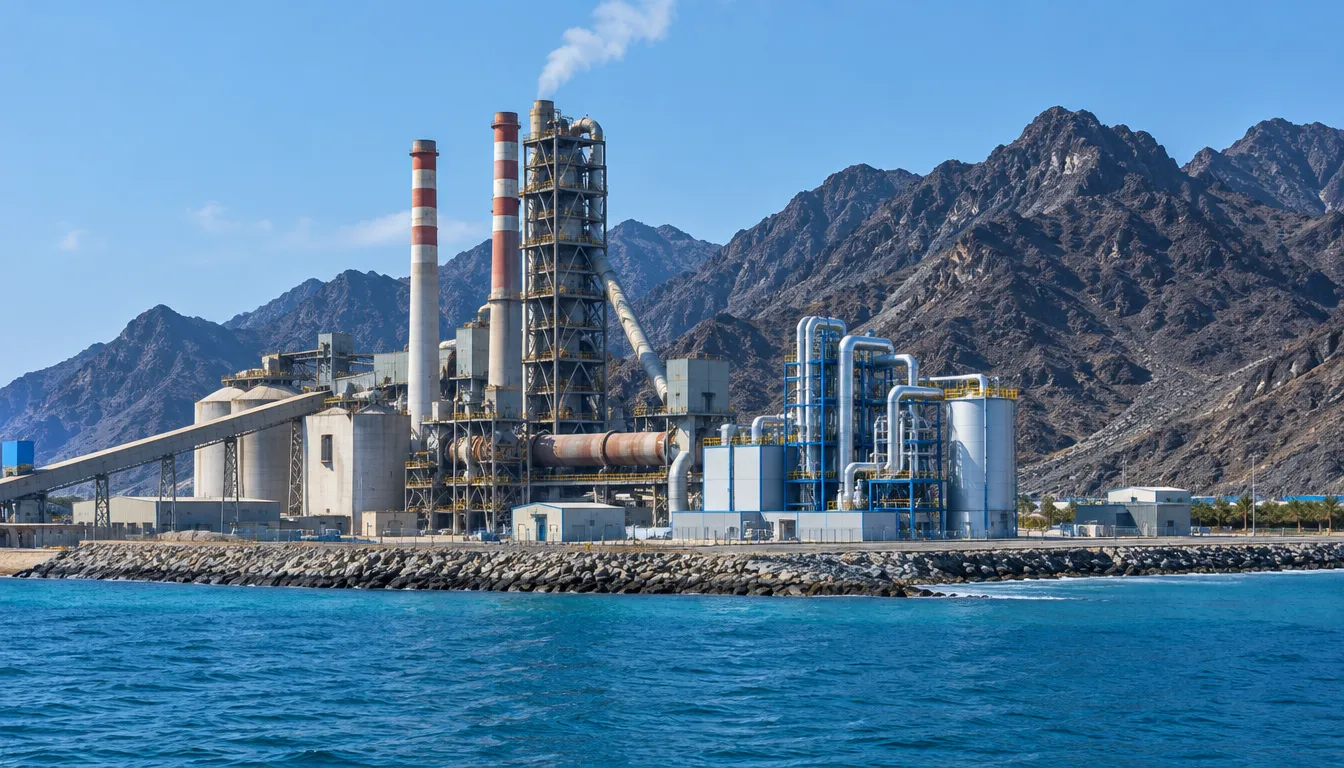
Holcim UAE and 44.01 have formally commissioned the UAE’s first industrial Fujairah carbon capture pilot, which stores cement plant CO2 in underground rock and gives heavy industry a working template for Net Zero 2050.
Holcim UAE and carbon storage company 44.01 officially commissioned the UAE’s first live-condition carbon capture and underground mineralisation pilot on 5 October. The facility sits at the Holcim Emirates Cement Plant in Fujairah. This Fujairah carbon capture pilot gives the country’s cement sector a working template for permanent storage under the UAE’s Net Zero 2050 target.
The unit takes CO2 from the flue gas of an operating cement works. The pilot is designed to capture 4 to 4.5 tonnes of CO2 a day. The gas is then injected deep underground into ultramafic rock formations that occur naturally in Fujairah. There the CO2 reacts with the rock and turns into solid minerals within months to years.
Live running since July
The plant started continuous carbon capture in July 2026. Holcim UAE says the pilot has since shown that capture and mineralisation can run alongside cement production without cutting efficiency or product quality.
The project is a six-month trial that gathers real-time performance data. The Fujairah Natural Resources Corporation and the Fujairah Environment Authority support it. The results will inform assessments of large-scale mineralisation in the UAE and globally.
Executives call it a blueprint
Ali Said, CEO of Holcim UAE & Oman, said: “Today’s ceremony is more than a celebration, it is confirmation that industrial decarbonisation works in practice, not just on paper.” He tied the project to the company’s strategy. “Commissioning it officially today reflects the scale of ambition behind Holcim’s NextGen Growth 2030 strategy: to lead industrial decarbonisation in the UAE with solutions that are scalable, sustainable, and ready today,” he said.

Talal Hasan, founder and CEO of 44.01, said: “This project demonstrates mineralisation as a real-world solution to address industrial emissions from sectors such as cement.” He called the pilot a blueprint. “This is a blueprint, proving how local geology and industrial infrastructure can unite to deliver permanent carbon storage across the region,” he said.
Cement is a hard-to-abate sector because much of its CO2 comes from the chemical process itself. Abu Dhabi has also introduced a new carbon capture policy. Operators across the Gulf will watch the pilot’s six-month data to judge whether Fujairah carbon capture can scale to commercial volumes.

