

 5:30 am - October 15, 2026
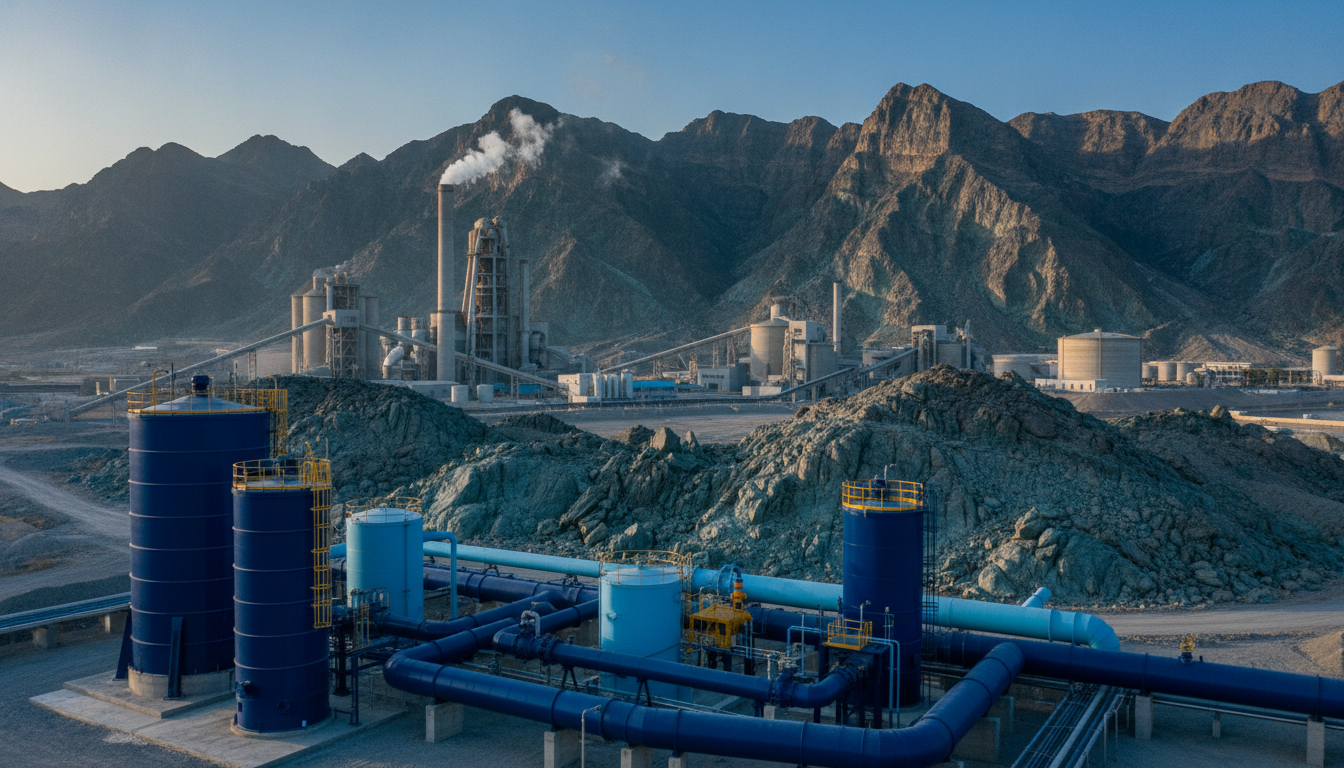
Holcim UAE and 44.01 have brought the country’s first continuous cement carbon capture and underground mineralisation pilot into full operation in Fujairah, capturing up to 4.5 tonnes of CO2 a day.
The UAE’s first continuous carbon capture and underground mineralisation pilot for the cement industry is now running full time in Fujairah, Holcim UAE and carbon storage company 44.01 said. The plant has operated continuously since 15 July, following its commissioning day.
The unit captures CO2 directly from the flue gas of Holcim’s Fujairah cement plant. It is designed for 4 to 4.5 tonnes a day. The captured gas travels to 44.01’s injection site, where it goes deep into Fujairah’s naturally occurring ultramafic rock. There it reacts with the rock and turns into solid carbonate, a permanent form of geological storage.
When the two companies announced the partnership last year, they described it as the first project globally to combine CO2 captured from a cement plant with in-situ mineralisation. The original design targeted 5 tonnes a day.
“When we announced this partnership, we set out to prove that industrial decarbonisation is not a far-off goal, but an immediate reality,” said Ali Said, chief executive of Holcim UAE and Oman. “Achieving full-time capture and mineralisation at our Fujairah plant is an important step forward.”
The pilot rests on a mix of public and private partners. Fujairah Natural Resources Corporation and the Fujairah Environment Authority handle the permitting and resource side. NT Energies, a joint venture between Technip Energies and NMDC Energy, supplied the capture plant using Shell CANSOLV technology. Gulf Cryo handles the gas.

Over the next six months the partners will gather operational data on the full cycle, from capture and specialised transport to injection under live industrial conditions. That evidence determines whether the model can be scaled and sold commercially.
“By integrating our in-situ mineralisation technology with Holcim’s live cement operations, we are proving that permanent carbon storage can be deployed today to decarbonise an industrial site,” said Talal Hasan, founder and chief executive of 44.01.
Cement sits among the hardest sectors to abate. Roughly 60 per cent of its emissions come from the chemistry of turning limestone into clinker, so fuel switching alone cannot remove them. Capture and permanent storage is one of the few routes available, which makes the Fujairah data relevant well beyond one plant.
For the UAE, the pilot gives the Net Zero 2050 pathway a working example of industrial carbon storage on home soil, using local geology rather than export pipelines. The volumes are small. The question the next six months answer is whether the cost and reliability hold up at scale.

